Preparing for surgery
What to do in the weeks and days before your procedure.
Before your surgery
- Telephone our rooms on (07) 3876 7455Call two days prior to your surgery to confirm your arrival and fasting times.
- Pay the known gap for your surgeryUse the secure payment link on your Surgical Procedure Estimate. You will also receive an SMS message with this link.
- Read, sign and return the Surgical Consent FormThis is given to you in person at the time of booking your surgery, or sent separately by email.
- Fast for your procedure as instructedSee the fasting guidance below. Your own times are confirmed when you call us.
- Register your admission with The Wesley HospitalBook your admission online at wesley.com.au/patients-and-visitors/admissions. If you are unable to complete your booking online, a member of the Clerical Pre-admissions Team will contact you closer to your admission date, or you can call (07) 3232 7777 between 8am to 9pm, Monday to Friday.
Medication alert
It is your responsibility to check with your treating physician and/or cardiologist about whether you should cease your medications, and when you should restart them after surgery. Please tell us if you take anything on this list.
Type 2 diabetes medications
Anticoagulants
Do not stop these without instructions from your surgeon.
Blood-thinning medications
It may be necessary to make some modifications prior to your surgery. Please check with your treating physician and/or cardiologist for guidance.
Weight-loss and diabetes injections
Keep taking these as you normally would. Because they slow the emptying of your stomach, your preparation starts the day before your procedure — see Fasting below.
Herbal and dietary supplements
If you regularly take any of the following, these should be ceased 10 days prior to your surgery, and you should notify your treating surgeon.
Sleep apnoea and alcohol
If you use a CPAP machine or a mouthpiece for sleep apnoea at home, you must bring it with you to hospital on the day of your surgery.
It is highly recommended that no alcohol is consumed for a minimum of 48 hours prior to surgery. If you consume more than three standard drinks a day on average, please make sure our doctor is aware.
Fasting before your surgery
Fasting — not eating or drinking — is essential prior to sedation or a general anaesthetic. Fasting reduces the risk of regurgitating the contents of the stomach which, if it occurs, may lead to damage to the lungs by the stomach acid.
Some people have medical conditions which require specific or different instructions and, if this applies to you, these instructions will be given to you by your doctor. Each hospital also has its own instructions that you should follow. Your own fasting times are confirmed when you telephone our rooms two days prior to your surgery.
The following fasting guidelines are recommended by the Australian and New Zealand College of Anaesthetists (ANZCA):
- For adults having an elective procedure, limited non-fatty solid food may be taken up to six hours prior to anaesthesia. In most circumstances, patients are encouraged to drink water for up to two hours prior to anaesthesia. Cloudy or milk-based drinks, or alcohol, are not to be taken.
- Prescribed medications may be taken with a sip of water less than two hours prior to anaesthesia, unless otherwise directed.
- Chewing gum must be discarded.
ANZCA publishes this advice for patients at Eating and drinking before your surgery.
If you take a weight-loss or diabetes injection
These medications — liraglutide, semaglutide, dulaglutide and tirzepatide — slow the emptying of your stomach, so your preparation starts the day before your procedure rather than on the morning. Keep taking the medication as you normally would. Your hospital or doctor will advise you on all your other medications.
The day before — clear fluids only
Do not eat any solid food on the whole day before your procedure. Clear fluids have no particles in them at all and can usually be seen through.
Clear fluids — these are fine
- Water
- Black tea or black coffee
- Carbohydrate (sugar) rich drinks developed especially for before and after surgery
- Clear broths or clear miso soup, without any solids such as seaweed or tofu
- Clear cordial, eg lemon
- Apple juice
- Clear soft drinks, eg lemonade
- Jelly
- Icy poles
- Electrolyte "sports" drinks
Not clear fluids — avoid these
- Drinks containing milk
- Yoghurt drinks
- Ice cream
- Cloudy fruit juices, eg prune juice
- Fruit juices containing pulp, eg orange juice
- Alcohol
- Soluble fibre, eg Benefiber, Metamucil
Alcohol is not recommended at any time during fasting.
The day of your procedure
Do not eat any solid food. Follow the timing for whichever part of the day your procedure falls in.
- Stop clear fluids
- Midnight the night before
- Water only
- From when you wake, small amounts of water only — up to half a cup (125 ml) each hour, from midnight until 6am, or as directed
- Stop all drinks
- From 6am, or the time your hospital has given you
- Stop clear fluids
- 6am on the morning of your procedure
- Water only
- From when you wake, small amounts of water only — up to half a cup (125 ml) each hour, until 11am, or as directed
- Stop all drinks
- From 11am, or the time your hospital has given you
If you have not followed these instructions
You may still be able to have your procedure. Start following the instructions from wherever you are on the timeline above, and contact the hospital as soon as you can to tell them when you began fasting — that information matters for your safety.
If you have diabetes, particularly if you take insulin, or you are having bowel preparation for a colonoscopy or barium enema, ask your doctor for instructions specific to you.
This is a guide and does not replace the instructions your anaesthetist gives you. Source: ANZCA, Preparing for your medical procedure when taking some diabetes and/or weight loss medications (PDF).
On the day — where to go
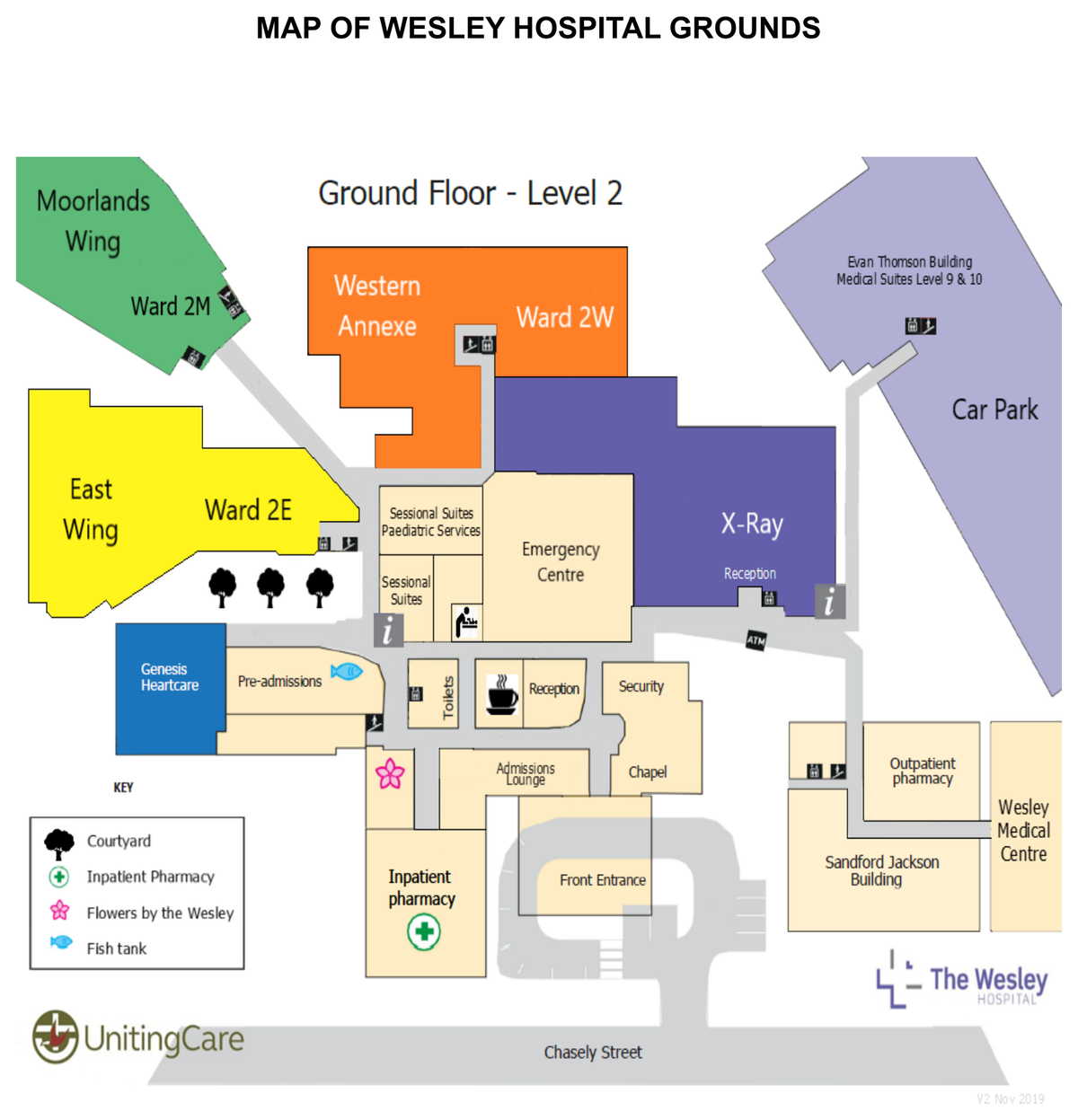
Pre-admissions and the Admissions Lounge are on the ground floor (Level 2) of The Wesley Hospital, off Chasely Street. Your admission letter confirms where and when to arrive.
Staying nearby
If you are travelling for your surgery, these are within walking distance of The Wesley Hospital. They are independent businesses, not part of the practice or the hospital — please book, and confirm current rates, with them directly.
Lang Parade Lodge
200 m from the hospital, on the corner of Cue Street and Lang Parade. There are 25 self-contained apartments with kitchenettes. Full laundry facilities are also available.
The Oasis Apartments
One, two and three bedroom apartments beside the Brisbane River, on Coronation Drive at Auchenflower, two kilometres from the heart of the city.
Chasely Apartment Hotel
Overlooks the Brisbane River, opposite the Wesley Hospital. One and two bedroom apartments on the main bus, CityCat and train routes, close to Suncorp Stadium and the restaurants on Park Road.